

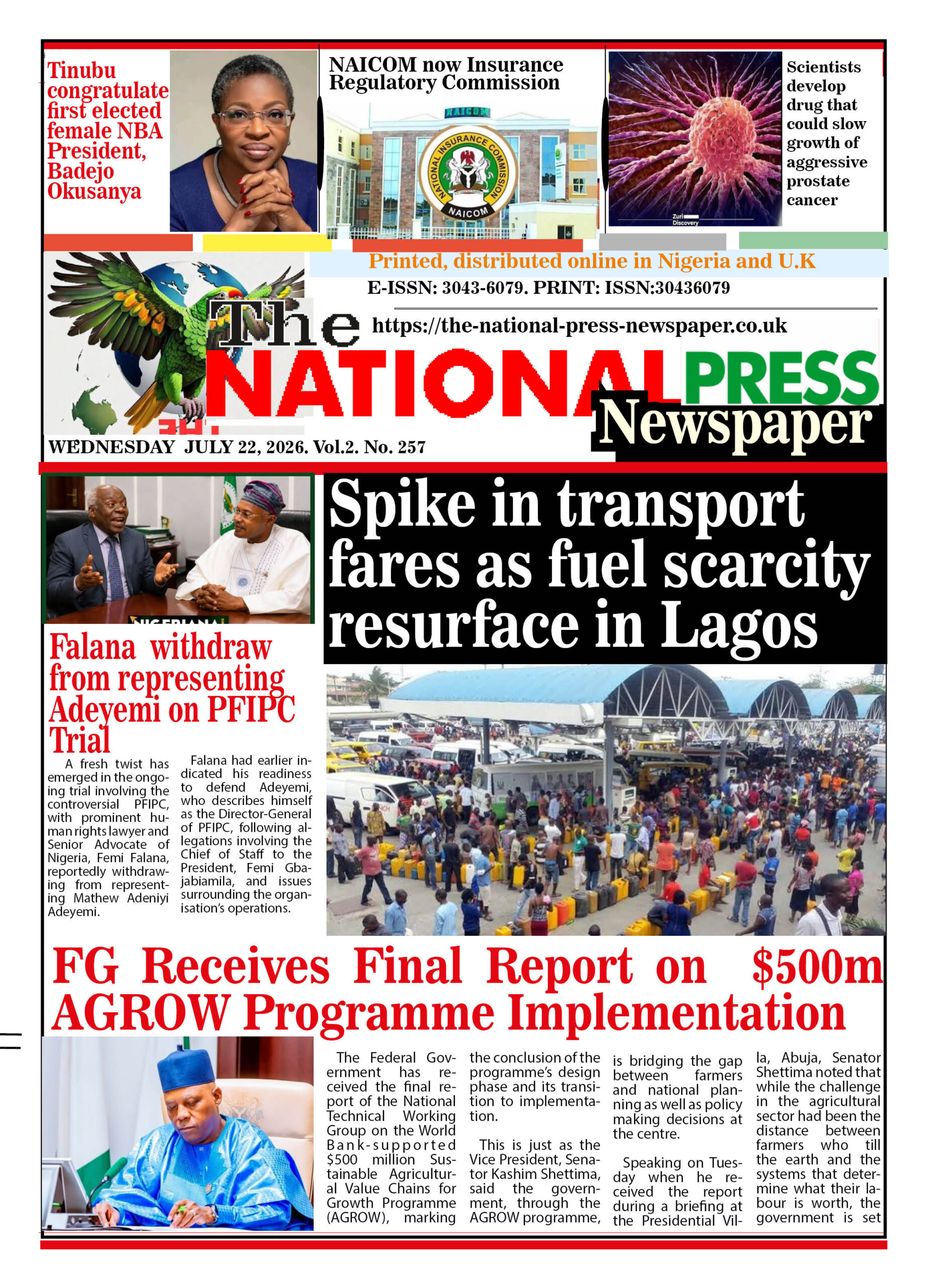
The National Press Newspaper cover for Wednesday July 22, 2026
https://the-national-press-newspaper.co.uk/the-national-press-newspaper-cover-for-wednesday-july-22-2026/
Spike in transport fares as fuel scarcity resurface in Lagos
https://the-national-press-newspaper.co.uk/spike-in-transport-fares-as-fuel-scarcity-resurface-in-lagos/
Fuel queues have resurfaced in Lagos and other major cities due to severe petrol supply issues, surging landing costs, and pricing tensions.
Marketers indicate that a hostile operating environment—driven by skyrocketing diesel prices for transporting fuel and high ex-depot costs—has forced many filling stations to reduce operations or shut down entirely.
Furthermore, a recent decision by the Dangote Petroleum Refinery to sell petrol to marketers in US dollars, alongside rising global crude prices from the US-Iran crisis, has driven domestic petrol prices to ₦1,230 per litre.
Most independent marketer outlets across Lagos are shut down.Extreme Commute Delays: The few stations selling fuel have massive vehicle queues causing traffic gridlocks.
Commercial transport drivers are charging double the usual rates to balance out the high fuel costs and long wait times.
Unlicensed “black market” sellers are taking advantage of the scarcity, hawking petrol in jerry cans at vastly inflated prices.
Parallel long queues have heavily hit Compressed Natural Gas (CNG) refueling stations across Lagos as motorists rush to convert their vehicles away from expensive petrol.
Major queues and traffic built up heavily around outlets in: Ikeja, Maryland, Oshodi, Yaba, Surulere, Lekki
Okusanya
Tinubu congratulates first elected female NBA President, Badejo Okusanya
https://the-national-press-newspaper.co.uk/tinubu-congratulates-first-elected-female-nba-president-badejo-okusanya/
President Bola Ahmed Tinubu warmly celebrates Mrs Oyinkansola Badejo-Okusanya, SAN, on her historic election as the first elected and second female President of the Nigerian Bar Association (NBA), describing her emergence as a watershed in the legal profession and a triumph for merit, excellence, and gender inclusion.
In a press release signed by Mr Bayo Onanuga, President Tinubu notes that Mrs Badejo-Okusanya’s remarkable career, distinguished by integrity, professionalism, and commitment to justice, has earned her the confidence of her colleagues across the country.
He affirms that Mrs Badejo-Okusanya’s emergence reflects the growing recognition of women’s invaluable contributions to nation-building and the administration of justice, and expresses confidence that her leadership will further strengthen the legal profession by upholding the rule of law and promoting reforms that enhance access to justice for all Nigerians.
President Tinubu urges the new NBA President to collaborate with all stakeholders to advance judicial reforms, protect the sanctity of the Constitution, and sustain the legal profession’s role as a vital pillar of a democratic society.
The President wishes her a successful tenure and assures her of his administration’s continued commitment to working with the Nigerian Bar Association to deepen democratic governance, promote justice, and build a more prosperous and united Nigeria.
“I extend my hearty congratulations to the President-elect of the NBA for her victory. As the first elected female president of the Association of Lawyers in Nigeria, Mrs Badejo-Okusanya has made history. She has once again shown that our women can attain any heights in pursuit of excellence in their careers and ambitions, both in the private sector and in public service.
“I urge you to reach out to the other contestants, unify the bar and make efforts to correct issues that arose during your election.
“I wish you a successful tenure and service to the legal profession and our country at large,” the President said.
Change of name in Insurance: NAICOM now Insurance Regulatory Commission
https://the-national-press-newspaper.co.uk/change-of-name-in-insurance-naicom-now-insurance-regulatory-commission/
The Senate has passed a bill to repeal and re-enact the law establishing the National Insurance Commission (NAICOM), paving the way for the regulatory agency to be renamed the Insurance Regulatory Commission (IRC).
This institutional restructuring is part of a broader legislative overhaul aimed at modernising the regulatory framework of Nigeria’s insurance industry, which has been governed by nearly three-decade-old laws that no longer align with global best practices.
According to Senator Tokunbo Abiru, Chairman, Senate Committee on Insurance and Financial “thee former “NAICOM” title was deemed insufficient to capture the commission’s evolving, comprehensive regulatory role in modernizing the market.
The new legislation aims to strengthen the financial ecosystem through several key changes:Enhanced Autonomy:
The commission gains greater operational independence to make regulatory decisions.
Introduces tougher penalties, including significant fines, license suspensions, and disqualifications for breaches.
Enhances the ability to intervene in distressed companies, safeguarding policyholders.
Provides legal immunity to the Commission and its officers while performing their duties.
Requires the Ministry of Finance to act swiftly to ensure continuity if the governing board’s term ends.
For the bill to become law, it requires concurrence from the House of Representatives and assent from the President
falana
Falana withdraw from representing Adeyemi on PFIPC Trial
https://the-national-press-newspaper.co.uk/falana-withdraw-from-representing-adeyemi-on-pfipc-trial/
A fresh twist has emerged in the ongoing trial involving the controversial PFIPC, with prominent human rights lawyer and Senior Advocate of Nigeria, Femi Falana, reportedly withdrawing from representing Mathew Adeniyi Adeyemi.
Falana had earlier indicated his readiness to defend Adeyemi, who describes himself as the Director-General of PFIPC, following allegations involving the Chief of Staff to the President, Femi Gbajabiamila, and issues surrounding the organisation’s operations.
However, sources familiar with the matter said the senior lawyer later stepped away from the case after reportedly encountering difficulties obtaining key documents and information needed to prepare the defence.
According to the sources, Adeyemi was unable to provide several documents requested by the legal team, a development they said influenced Falana’s reported decision to discontinue his involvement.
The sources also alleged that efforts were made to secure Adeyemi’s appearance before the court during earlier proceedings, but he failed to attend.
He was later arrested in Osun State after law enforcement authorities declared him wanted in connection with the case.
At proceedings before the Federal High Court in Abuja on July 14, 2026, Falana did not appear as counsel for Adeyemi. The defendant was also absent, prompting the court to issue a bench warrant for his arrest.
As of the time of filing this report, neither Falana nor his law chambers had issued an official statement confirming or denying the reported withdrawal. Efforts to obtain comments from the Senior Advocate were unsuccessful.
The case has continued to attract public attention amid concerns over organisations allegedly presenting themselves as government-affiliated institutions without official authorisation. The matter has been adjourned until September 30, 2026, for further proceedings.
cancer
Scientists develop drug that could slow growth of aggressive prostate cancer
https://the-national-press-newspaper.co.uk/scientists-develop-drug-that-could-slow-growth-of-aggressive-prostate-cancer/
Scientists at Umeå University in Sweden and partner institutions have developed an experimental drug that could slow the growth of aggressive prostate cancer and prevent it from spreading.
According to the findings, published in the journal Signal Transduction and Targeted Therapy, the treatment may offer a new approach to tackling metastatic prostate cancer.
Yahaya bello
Yahaya Bello name missing on INEC portal
https://the-national-press-newspaper.co.uk/yahaya-bello-name-missing-on-inec-portal/
The confusion regarding the All Progressives Congress (APC) not uploading former Kogi State Governor Yahaya Bello’s name stems from a highly publicised screening dispute. As at the time of writing this story, Yahaya Bello’s name is missing on INEC portal.
While conflicting documents initially leaked showing he was “not cleared” or omitted due to his ongoing EFCC legal trials, the APC ultimately cleared him to contest.
He successfully ran in the primary elections.
The “Not Cleared” Leak: In mid-May 2026, an internal APC screening document circulated heavily online listing Yahaya Bello as “NOT CLEARED”.
This led to widespread reports that the party had blocked or refused to upload his credentials due to corruption allegations.
The APC National Assembly Screening Committee subsequently dismissed the leak, confirming his eligibility. His name was uploaded as aspirant number 13 for the Kogi Central Senatorial District.
Following the resolution of the screening dispute, Yahaya Bello officially won the APC primary election on May 18, 2026. He swept all five local government areas in the district with 72,399 votes to defeat his challengers, Ibrahim Adoke and Momoh Yusuf Obaro.
Yahaya Bello is the official APC senatorial candidate for Kogi Central. Barring any future court disqualifications related to his EFCC cases, his name will be submitted to the Independent National Electoral Commission (INEC) for the 2027 general election, where he is scheduled to face the incumbent PDP senator, Natasha Akpoti-Uduaghan.
shettima
FG Receives Final Report on $500m AGROW Programme Implementation
https://the-national-press-newspaper.co.uk/fg-receives-final-report-on-500m-agrow-programme-implementation/
The Federal Government has received the final report of the National Technical Working Group on the World Bank-supported $500 million Sustainable Agricultural Value Chains for Growth Programme (AGROW), marking the conclusion of the programme’s design phase and its transition to implementation.
This is just as the Vice President, Senator Kashim Shettima, said the government, through the AGROW programme, is bridging the gap between farmers and national planning as well as policy making decisions at the centre.
Speaking on Tuesday when he received the report during a briefing at the Presidential Villa, Abuja, Senator Shettima noted that while the challenge in the agricultural sector had been the distance between farmers who till the earth and the systems that determine what their labour is worth, the government is set to implement the process of shortening that distance.
The US$500 million World Bank-supported programme was developed through seven zonal consultations involving 32 states, reflecting the increasing commitment of subnational governments to agricultural development and their readiness to assume greater responsibility for productivity, infrastructure, extension services and market development.
Speaking at the meeting, the Vice President described the AGROW programme report as “the conclusion of a design process that restores the farmer to the centre of our national economic reasoning, where he has always belonged.
“Today marks the transition of AGROW from programme design to implementation,” he added, maintaining that the World Bank US$500 million Nigerian agriculture programme is targeted at “developing a programme rooted in the realities of farmers, delivered through our States, and capable of attracting the private investment required to move agriculture from subsistence to scale.”
VP Shettima observed that agriculture, a sector that accounts for 23 per cent of the nation’s GDP and sustains 34 per cent of its workforce, must not be treated as “a negligible sector, attended to at leisure and financed at the margins.”
Noting that most Nigerians earn a living from the tilling of the soil, he said no other sector carries as many livelihoods or touches as many households as the agriculture sector.
“When yields rise, food prices ease, rural incomes recover, industries receive raw materials, and the pressure on our cities and foreign reserves begins to relax. When yields fall, the entire economy discovers the price of hunger.
“Productivity on the farm is therefore a question of growth, employment, food security and poverty reduction. What we do to the farm, we do to the nation,” he stated.
The Vice President expressed satisfaction with the response from states, saying it reveals the scale of the opportunity before the nation, even as he stressed that the participation of 32 states in seven consultations to shape AGROW reflects “both the urgency of the challenges confronting agriculture and the growing appetite across Nigeria for agricultural development and investment.”
On the method of implementation, the VP said, “Of the US$500 million financing envelope, US$355 million, representing 71 per cent, will be implemented through participating States. This rightly places State Governments at the centre of delivery because agriculture ultimately takes place within our communities, Local Government Areas and States.
“The participation of 32 States, however, also makes one fact unmistakable: US$500 million cannot meet the scale of demand or close the gaps accumulated over decades in extension services, infrastructure, technology, processing and market access. The appetite is evident. The resources are not yet sufficient.”
He commended members of the National Technical Working Group for their expertise, commitment and discipline in the process of producing the report, noting that by bringing together federal and state institutions, the private sector and development partners, the group “ensured that the programme was inclusive, evidence-based and technically rigorous.
“I hereby accept the Final Report and approve the formal dissolution of the National Technical Working Group, its mandate having been fully and satisfactorily discharged. Responsibility now passes to the Federal Ministry of Agriculture and Food Security, as Chair of the National Steering Committee and host of the Project Coordination Office,” he declared.
Senator Shettima also acknowledged the Presidential Food Systems Coordinating Unit for coordinating the design process and serving as Secretariat to the Technical Working Group.
Earlier, Nasarawa State Governor, Engr. Abdullahi Sule informed the Vice President of the commitment of the sub-nationals, stating that at a previous Nigerian Governors’ Forum (NGF) meeting, the World Bank had briefed the governors on the objectives of the working group and the initiative.
He thanked the Vice President for giving the respective states the opportunity to maximise the initiative, adding that the governors are fully in support of the laudable programme.
In the same vein, the Deputy Governor of Kaduna State, Hadiza Balarabe, expressed the state’s readiness to take advantage of the initiative, assuring the Vice President that the state government would establish a state-level coordination mechanism to ensure the timely implementation of the programme.
She said that already, the Kaduna State government allocates more than 13 per cent of its budget to agriculture, underscoring the importance of the sector as one of the key drivers of economic transformation in the state.
For his part, the Minister of Finance and Coordinating Minister of the Economy, Dr Taiwo Oyedele, thanked all partners in the project for their unwavering commitment, noting that the presentation of the report, which is a critical step towards implementation, was a reflection of what is possible if all stakeholders work together.
On the significance of AGROW, the Minister said the programme goes beyond food production as it constitutes an integral part of Nigeria’s economic transformation, macroeconomic stability and job creation drive, among other benefits.
In his remarks, Minister of Agriculture and Food Security, Sen Abubakar Kyari, applauded the leadership of Vice President Shettima in mobilising stakeholders for the design of the AGROW programme regarded as a game-changing intervention in Nigeria’s agricultural sector.
He assured all stakeholders of the ministry’s commitment to successful implementation of the programme in line with the Renewed Hope Agenda of Asiwaju Bola Ahmed Tinubu administration.
Kyari said the completion and presentation of the programme report by the National Technical Working Group (NTWG) has shifted attention to the next phase comprising the borrowing plan, financing agreement and legal opinion, among others, to complete the cycle from project design to implementation.
In her remarks, the World Bank Programme Leader for AGROW, Ms. Bertine Kamphuis, briefed the Vice President on the outcome of the working group’s national assignment, which, according to her, was initiated by the President and the Vice President.
She assured the Nigerian government of the bank’s continued support, adding that with the final report, Nigeria can do more to ensure that interventions translate into improved food security while lifting Nigerians out of poverty.
The official also noted that the PSFCU played a critical role in coordinating the states, adding that stronger private sector participation is required across the nation’s agricultural value chain.
She backed the creation of the right policies and an enabling environment for the private sector to step in while highlighting that critical institutions such as the Bank of Agriculture would play their role in delivering this agenda.
Highlighting the key achievements of the National Technical Working Group (NTWG), the Technical Advisor to the Vice President on Agriculture and the Executive Secretary of the Presidential Food Systems Coordinating Unit (PFSCU), Ms Marion Moon, said the group developed an eight-indicator framework to identify priority agricultural value chains by adopting an agroecological approach that matches crops and investments to Nigeria’s soils, rainfall, and growing conditions.
She added that the group conducted seven zonal consultations involving 32 states and key agricultural stakeholders, while consolidated stakeholder feedback informed the final AGROW programme design.
The highpoint of the meeting was the presentation of the programme report to the Vice President by the NTWG.


