

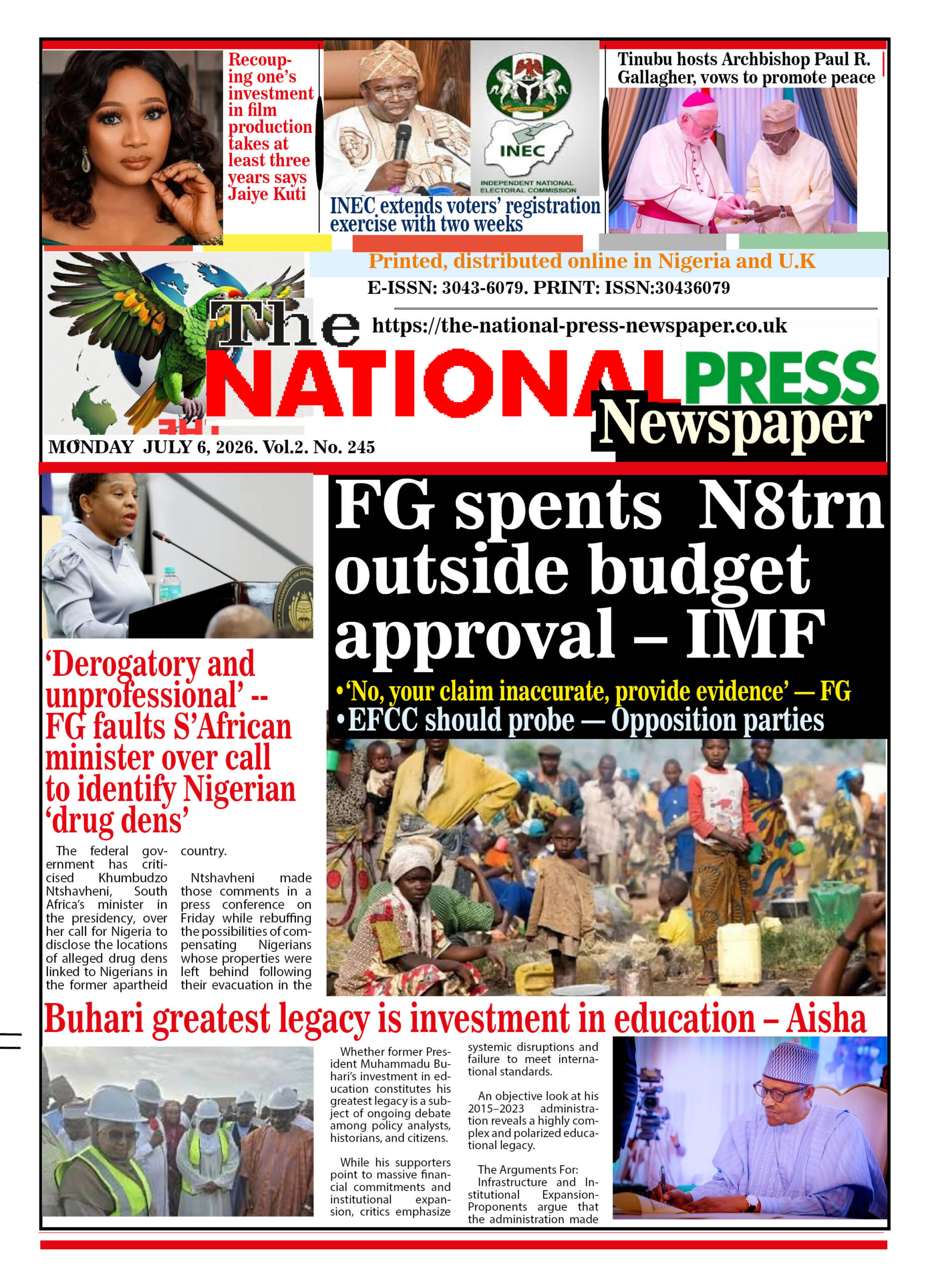
The National Press Newspaper cover for Monday July 6, 2026
https://the-national-press-newspaper.co.uk/the-national-press-newspaper-cover-for-monday-july-6-2026/
south
‘Derogatory and unprofessional’ — FG faults S’African minister over call to identify Nigerian ‘drug dens’
https://the-national-press-newspaper.co.uk/derogatory-and-unprofessional-fg-faults-safrican-minister-over-call-to-identify-nigerian-drug-dens/
The federal government has criticised Khumbudzo Ntshavheni, South Africa’s minister in the presidency, over her call for Nigeria to disclose the locations of alleged drug dens linked to Nigerians in the former apartheid country.
Ntshavheni made those comments in a press conference on Friday while rebuffing the possibilities of compensating Nigerians whose properties were left behind following their evacuation in the wake of anti-migrant tensions.
Buhari
Buhari greatest legacy is investment in education says Aisha
https://the-national-press-newspaper.co.uk/buhari-greatest-legacy-is-investment-in-education-says-aisha/
Whether former President Muhammadu Buhari’s investment in education constitutes his greatest legacy is a subject of ongoing debate among policy analysts, historians, and citizens.
While his supporters point to massive financial commitments and institutional expansion, critics emphasize systemic disruptions and failure to meet international standards.
An objective look at his 2015–2023 administration reveals a highly complex and polarized educational legacy.
The Arguments For:
Infrastructure and Institutional ExpansionProponents argue that the administration made unprecedented physical and structural contributions to Nigerian education:
The federal education budget experienced massive nominal growth, rising from ₦369.6 billion in 2016 to an all-time high of ₦2.05 trillion in 2023.
Over his eight-year tenure, his administration allocated roughly ₦6.798 trillion to the education sector.
Buhari’s leadership oversaw the aggressive expansion of tertiary options, establishing over 37 new federal institutions.
This included 18 universities (such as the specialized Federal University of Transportation, Daura, and the Nigerian Army University, Biu), 10 polytechnics, and several colleges of education to improve regional access to schooling.
Through the Universal Basic Education Commission (UBEC) and the Tertiary Education Trust Fund (TETFUND), the government revitalized neglected primary infrastructure and established 12 Academic Centres of Excellence across the country.
The introduction of the National Home Grown School Feeding Programme served as a major educational incentive, boosting enrollment numbers by providing daily meals to millions of public primary school pupils.
Strikes, Inflation, and Funding GapsConversely, many education experts and critics argue that the sector actually deteriorated due to deep systemic crises:
Despite the nominal multi-trillion naira figures, education spending under Buhari consistently hovered between 4.95% and 10.8% of the national budget.
This fell far short of the United Nations Educational, Scientific and Cultural Organization (UNESCO) recommendation to allocate 15% to 20% of public expenditure to education.
The administration’s tenure was heavily marred by recurring industrial friction. Most notably, disputes with the Academic Staff Union of Universities (ASUU) resulted in over 610 days of cumulative strike actions, paralyzing public university calendars for months at a time.
Despite local initiatives, economic pressures and worsening regional insecurity meant that Nigeria struggled with exceptionally high numbers of out-of-school youth throughout his terms.
Critics point out that massive inflation and the steep devaluation of the Nigerian Naira during those eight years heavily diluted the purchasing power of the increased budgets, making real-term institutional funding lower than it appeared on paper.
Alternative Contenders for Buhari’s “Greatest Legacy”Many political analysts argue that Buhari’s defining legacy lies completely outside the classroom, pointing instead to:
Physical Transport Infrastructure: The completion of landmark multi-billion dollar projects like the Second Niger Bridge, the Lagos-Ibadan Standard Gauge Rail Line, and major airport terminal overhauls.
Enacting transformative economic and governance legal frameworks, such as the Petroleum Industry Act (PIA), the Not Too Young to Run Act, and strict enforcement of the Treasury Single Account (TSA).
Boosting domestic food production through aggressive protectionist trade policies and central bank interventions like the Anchor Borrowers’ Programme.Ultimately, while the expansion of institutional infrastructure is undeniable, whether it stands as his greatest legacy depends on whether one prioritizes the physical growth of the school system or the turbulent realities experienced by Nigerian students during that era
jaiye kuti
Jaiye Kuti: Recouping one’s investment in film production takes at least three years
https://the-national-press-newspaper.co.uk/recouping-ones-investment-in-film-production-takes-at-least-three-years-says-nigeria-actress/
Jaiye Kuti, the Nollywood actress, says it takes about three years to recover investment in cinema films
In an interview on Oyinmomo, the film star said recovering the cost of a cinema production is a gradual process that requires a lot of patience.
budget
FG spents N8trn outside budget approval says IMF
‘No, your claim inaccurate, provide evidence’ — FG
*EFCC should probe says Opposition parties
https://the-national-press-newspaper.co.uk/fg-spents-n8trn-outside-budget-approval-says-imf/
The federal government says the International Monetary Fund’s (IMF) claim that Nigeria omitted some public spending from recent budgets is inaccurate and misleading the public regarding the government’s financial management.
Christian Ebeke, the resident representative of the IMF in Nigeria, on Wednesday, said the off-budget spending is worth 2 percent of gross domestic product (GDP), and the discrepancy means Nigeria’s fiscal deficit appears smaller than the government’s actual borrowing needs.
It would be recalled that the main opposition parties in Nigeria, has called for deep probe of the Tinubu lead Federal Government over IMF’s claim of Nigeria spending ‘N8.8trn’ off-budget
Atiku Abubakar, former vice-president, Peter Obi, all main opposition parties in Nigeria has called on the Economic and Financial Crimes Commission (EFCC) and the Independent Corrupt Practices and Other Related Offences Commission (ICPC) to probe the allegation that Nigeria omitted public spending worth 2 percent of gross domestic production (GDP) from recent budgets.
Christian Ebeke, the resident representative of International Monetary Fund (IMF) in Nigeria, made the allegation on Wednesday, adding that the discrepancy means Nigeria’s fiscal deficit appears smaller than the government’s actual borrowing needs.
Ebeke said the discrepancy means Nigeria’s fiscal deficit appears smaller than the government’s actual borrowing needs because some capital expenditure was excluded from budget documents and implementation reports.
In a statement on Saturday, Atiku said with Nigeria’s economy currently valued at approximately N441.5 trillion, the 2 percent discrepancy translates to N8.8 trillion in public funds spent without legislative approval, audit, or public accountability.
He alleged that the Bola Tinubu administration is replicating the “Lagos playbook” at the national level.
“The IMF’s latest Article IV consultation, articulated by its resident representative in Nigeria, Christian Ebeke, confirmed that this staggering discrepancy arises from large-scale government projects executed entirely off-budget,” Atiku said.
“Let us be absolutely clear about what this means: The Tinubu administration is awarding multi-trillion naira contracts, moving massive public capital, and commissioning infrastructure projects entirely beyond the reach of the Auditor-General, the nation’s procurement laws, and the legitimate oversight of the National Assembly. It is a parallel fiscal universe, one governed by executive whim.”
POPE
Tinubu hosts Archbishop Paul R. Gallagher, vows to promote peace and tolerance using religious leaders
https://the-national-press-newspaper.co.uk/nigerian-government-will-continue-to-partner-with-religious-leaders-to-promote-peace-and-tolerance-president-tinubu/
President Bola Ahmed Tinubu, on Saturday in Abuja, reaffirmed his administration’s commitment to prioritising interfaith dialogue and promoting peace, harmony, and tolerance among Nigeria’s diverse religious communities.
The President made this statement while receiving in audience Archbishop Paul R. Gallagher, the Secretary for Relations with States and International Organisations of the Holy See, at his residence in Abuja. Archbishop Gallagher was ushered in by the Minister of Foreign Affairs, Ambassador Bianca Ojukwu.
President Tinubu said interfaith dialogue is the only path to addressing the country’s security challenges.
He told the Archbishop that he had a long and cordial relationship with the Catholic Church, especially during his time as governor in Lagos. He said he strongly supports the Church’s contributions to education and health.
The President said this belief led him to prioritise returning mission schools to religious institutions as soon as he became governor. The schools were taken over during the previous military administrations.
“I appreciate the Pope. It was an honour for me to lead the Nigerian delegation to his inauguration as Pope Leo XIV. It was a moment of history. I see his efforts all over the world to promote World Peace. We need his spiritual engagement, as millions around the world look up to him. I look forward to receiving him in Nigeria.
“My administration will continue to work on religious harmony among all faiths. Our Bishops and religious leaders have been doing a great deal. Please tell them to continue the good work they are doing. Let them continue to preach peace and tolerance. We cannot have an excess of that.
“I understand the roles that the Catholic church has been playing in expanding the frontiers of education, health and humanitarianism in Nigeria. It means a lot to us in Nigeria, and the country is benefiting from it.
“We are also doing a lot to guarantee freedom of worship. As you may be aware, my wife is a pastor at an evangelical church. This downplays the religious connotation that the religious controversy in our country might have taken.”
President Tinubu assured his guest that the Nigerian military has made significant progress in recent times and remains committed to sustaining these achievements, recognising that a single incident can undermine previous gains. He stated that more resources are being allocated to security, with intensified surveillance, particularly in previously ungoverned areas.
The President assured the Archbishop that his government is also investing in the youth to prevent their exploitation by terrorists and reduce vulnerability to radicalisation.
Archbishop Gallagher said he was in Nigeria for the 50th anniversary of the establishment of relations between the Federal Republic of Nigeria and the Holy See, noting that Nigeria is very strategic to the Catholic Church because of its vibrant Catholic community.
He also conveyed Pope Leo XIV’s appreciation for President Tinubu’s presence at his inauguration. He shared his impressions of Veritas University, established by the Catholic community in Abuja, noting its remarkable progress.
He described Nigeria as the heart of Africa and home to some of the most successful activities of Bishops on the continent. He commended President Tinubu’s efforts in promoting peace, particularly through military initiatives, and encouraged continued dedication. He also expressed appreciation to the Nigerian government for facilitating visas for bishops and for its responsiveness to the Church’s various needs.
Archbishop Gallagher informed President Tinubu that he looks forward to receiving the Nigerian Ambassador to the Holy See in a few weeks and assured him that this visit would be the first of several special visits from the Holy See.
Accompanying Archbishop Gallagher were H.E. Archbishop Michael F. Crotty, Apostolic Nuncio to Nigeria; Rev. Monsignor Suman Paul Anthony, Official of the Secretariat of State – Section for Relations with States and International Organisations; and Rev. Monsignor Patarne Koyassambia-Kozondo, First Secretary, Apostolic Nunciature in Nigeria.
INEC
INEC extends voters registration with two weeks
https://the-national-press-newspaper.co.uk/inec-extends-voters-registration-with-two-weeks/
The Independene National Eletoral Commission, INEC, authorised electoral umpire in Nigeria has approved a two-week extension of the continuous voter registration exercise.
The CVR exercise which started 18th August, 2025 and was originally scheduled to conclude on 10th July 2026 has been extended to 24th of July as requested by eligible voters to provide additional opportunity to for the Commission to accommodations more eligible electorate.
The extension underscores the Commission’s commitment to ensuring that every eligible Nigerian has a fair and reasonable opportunity to be included in the Register of Voters ahead of future electoral activities.


