

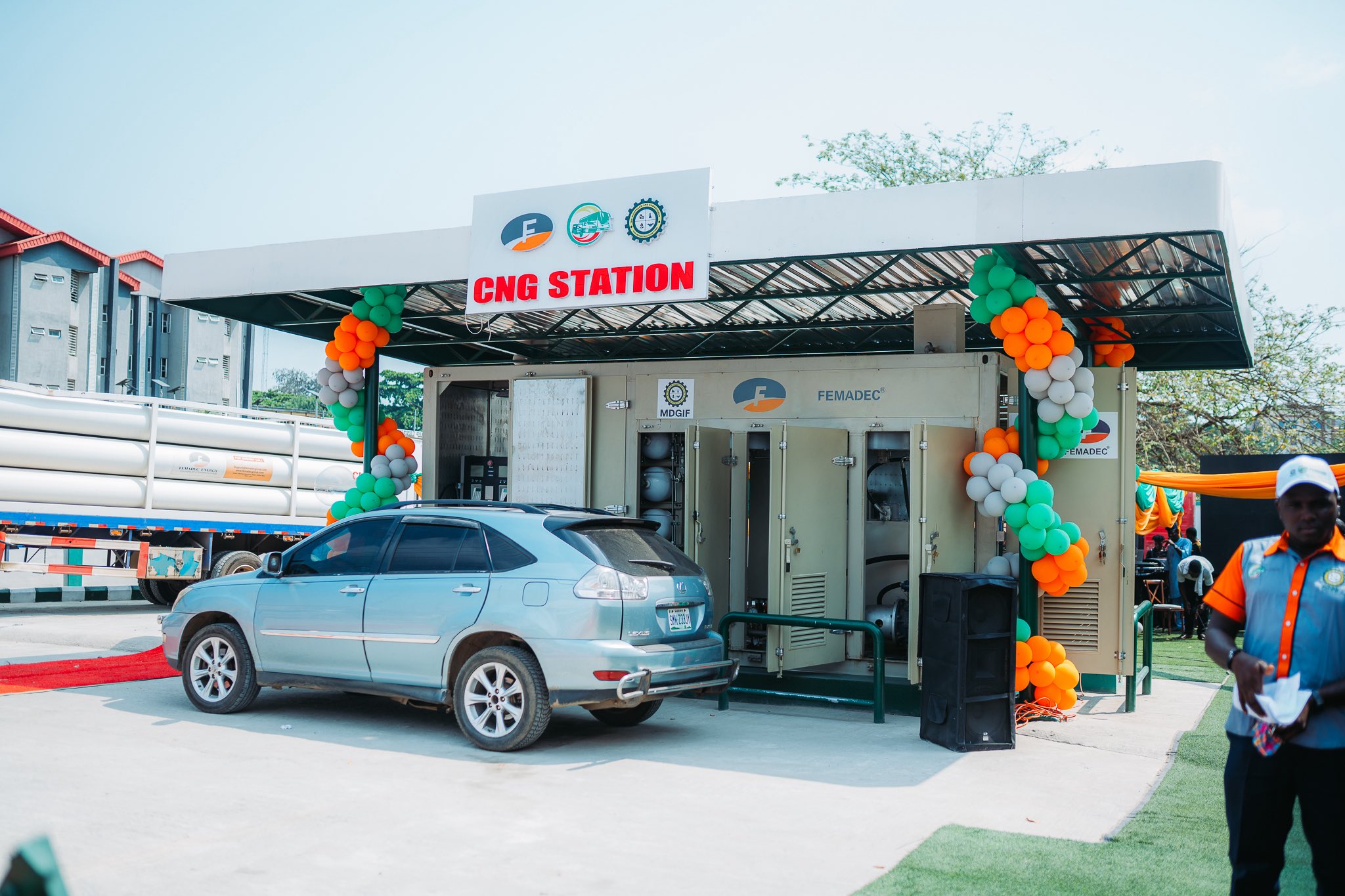
The Midstream and Downstream Gas Infrastructure Fund (MDGIF) has commissioned four more Compressed Natural Gas (CNG) daughter stations in federal universities, delivered through its joint venture with FEMADEC Energy Limited.
The Honourable Minister of Education, Dr. Tunji Alausa, CON, led the commissioning at the University of Lagos (UNILAG), where the facility includes a CNG daughter station and a vehicle conversion centre.
The University of Ibadan, the Federal University of Technology, Akure, and the Federal University Oye‑Ekiti joined the ceremony by live link to commission their own stations.
The UNILAG facility is the 11th CNG station commissioned by MDGIF in Lagos State. It also brings the number of universities served by the MDGIF and FEMADEC joint venture nationwide to 11.
The Executive Director of MDGIF, Mr Oluwole Adama, said the milestone shows how quickly CNG is taking root. “Eleven stations in one state is a clear signal that CNG is no longer a promise for tomorrow. In Lagos, it is becoming part of everyday life,” he said.
Adama said that in just two years, MDGIF has supported the delivery of 25 fully operational CNG stations nationwide. Its portfolio now stands at 31 projects made up of 205 infrastructure assets across the country.
He added that nine more university stations, mostly in the North, will be commissioned within a few weeks.
“The figure that matters most to me is not the number of stations. It is the number of Nigerians who can put this infrastructure to productive use,” Adama said.
Adama thanked President Bola Ahmed Tinubu, GCFR, whose inauguration of the MDGIF Governing Council gave fresh momentum to domestic gas utilisation. He gave special commendation to the Minister of Education for championing Project SPROUT and personally engaging Vice‑Chancellors, who allocated land for the stations.
The Special Palliative Relief on University Transportation (SPROUT) is a Federal Government initiative to lower commuting costs for students and staff through the use of CNG. It is designed to reach 20 federal universities.
Dr. Alausa said the programme responds to a concern students raise directly. “We are addressing one major concern students raise with us directly: the cost of getting to class,” he said.
“For most of our students who make several trips a day between their accommodation, lecture halls and laboratories, even a modest saving on each journey can make a difference,” the Minister added.
The National President of the National Association of Nigerian Students (NANS), Comrade @iambabtee , commended MDGIF, FEMADEC and the Minister of Education on behalf of over 40 million Nigerian students.
He said transport remains one of the biggest daily expenses for students, and that the programme’s success must be measured by affordable fares and reliable services on campus.
“When we reduce the cost of transportation for students, we are not just making movement easier; we are making education more accessible and supporting the future of our country,” he said.
The Chief Executive Officer of FEMADEC Energy Limited, Engr. Fola Akinnola, thanked MDGIF for its funding and institutional backing. He said six more universities will be commissioned before the end of the year, with the remaining three in the first 20 campus rollout due early next year.
Akinnola said each station is designed as a living laboratory, giving engineering and technical students hands‑on exposure to gas infrastructure, vehicle conversion, maintenance and safety standards.
The Vice‑Chancellor of the University of Lagos, Professor Folasade Ogunsola, who hosted the event, welcomed the project as the kind of partnership the university is keen to embrace. She said the facility would make a significant difference to the university’s transport network, easing movement for students and staff across the campus.


