

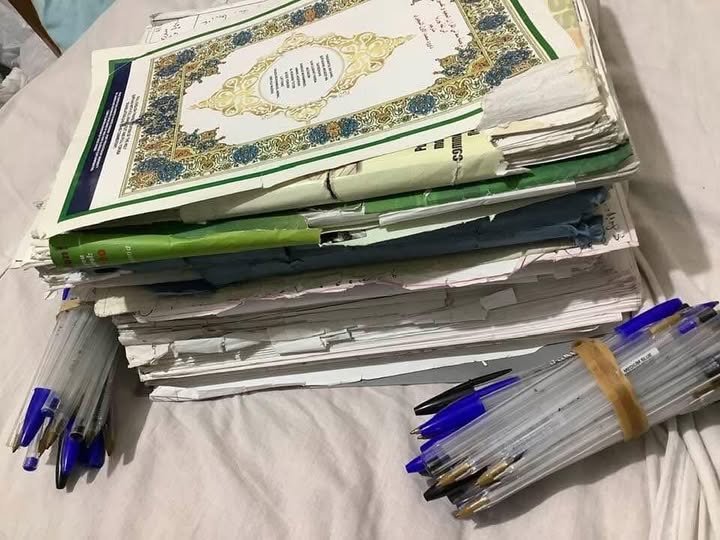
1.A-22-Year Journey of Dedication
This project took 22 years to complete-a journey marked by relentless dedication, sleepless nights, countless hours of research. I invested significant time, energy, and financial resources, often travelling to acquire suitable materials and references.
2.Complexity of Transliteration
I used Roman script for transliteration alongside English language formatting to ensure accuracy and accessibility. This process required precision to capture the true phonetics of Arabic words.
3. Extensive Research and Book Collection
I read dozens of classical and modern books on Qurr’anic sciences, Arabic linguistics, and translation. I purchased and studied many rare and modern references to ensure the highest fidelity in meaning and context.
4. Cross-Checking Other Authors Work
I carefully reviewed and evaluated the works of other authors in order to identify gaps, errors, and strengths. This comparative approach ensured that my translation and commentary stood out as accurate, detailed, and innovative. I commend their great efforts.
5.Linguistic and Cultural Expertise
My deep knowledge of Arabic Language, Islamic studies, and Yoruba culture, combined with my expertise in linguistics, investigative skills and cultural studies gave me the unique skills required for this project. The integration of these disciplines was essential to achieving a faithful translation and meaningful commentary.
6.Overcoming Financial and Technical Constraints
Funding the printing, research trips, and acquisition of resources was challenging. However, my passion for this World-First Yoruba-English Qur’an 4-in-1 project sustained me through every obstacle.
My Journey and Challenges in Translating the Qur’an
When I began this project more than 22 years ago, I could not have imagined the depth of commitment, sacrifice, and perseverance it would require. Translating the Glorious Qur’an into Yoruba and English simultaneously, while preserving the Original Arabic text and providing accurate translation, was not just an academic pursuit-it became a spiritual and intellectual journey of a lifetime.
A Journey of 22 Years
This project consumed over two decades of my life, during which I dedicated countless days and sleepless nights to ensure every word and every nuance of meaning was conveyed with precision. I spent thousands of hours in research, traveling extensively to gather suitable materials, visiting libraries, consulting scholars, and purchasing rare books and references that could assist me in this monumental task.
There were moments when the weight of this project felt overwhelming, but my faith in Allah and my conviction that this work would serve generations kept me going.
Linguistic and Cultural Challenges
Translating the Qur’an is not a mere word-for-word exercise, it requires an in-depth understanding of the linguistic beauty of Arabic language, its grammar, morphology, and syntax. I was blessed with deep expertise in Classical Arabic and Islamic sciences-a skill set that I honed during my studies at Muhammad Ibn Saud University in Riyadh, London School of Journalism and earlier at Markaz College Agege, Lagos.
I appreciate all my teachers, mentors, parents’ uncle, family, friends, fans, and well-wishers both Muslims and non-Muslims across the Globe.
Additionally, I faced the challenges of conveying these meaning in Yoruba, some language rich in proverbs, cultural expressions, and layered meanings. I was determined to avoid the errors I found in earlier Yoruba translations-some of which misrepresented key Qur’anic terms due to a lack of Arabic linguistic expertise. This required me to draw on my linguistic and cultural knowledge, ensuring the translation remained faithful to the original while resonating with Yoruba speakers.
The Challenge of Transliteration
Another monumental task was producing a Romanized transliteration of the entire Qur’an. This step was vital because many Yoruba-speaking Muslims, particularly children and new learners, find reading Arabic script challenging. I discovered that most existing transliterations contained serious pronunciation errors, which could alter the meaning of the original verses.
By carefully crafting an accurate Roman transliteration, I provide readers with a tool to recite the Qur’an correctly, even if they are not fluent in Arabic.
Extensive Research
This project required immense research and comparative analysis. I read and reviewed the works of countless scholars and translators-in English, Arabic, and Yoruba. I commend their efforts and also evaluated their approaches, identified where earlier translations lacked depth or accuracy. I bought many books, some at great personal expense, because I believed that knowledge must be purchased, no matter the cost.
Personal Sacrifice
I personally funded much of the research, book purchases, and other expenses. There were times when I had to sacrifice personal comforts and make difficult choices to continue the project. Yet, I never wavered, because I believe this work would benefit millions of Yoruba-speaking Muslims across the World, including future generations.
Why I Took on This Challenge
I was motivated not only by my academic training but also by my love for my people and desire to bridge the gap between cultures and faith traditions. Yoruba is a language spoken by millions Worldwide, and yet the Qur’an had never been presented in a comprehensive 4-in-1 format that included:
1.The Original Arabic Text,
2. Full Roman transliteration
3.Yoruba translation, and
4.English translation with commentary, biblical references, scientific insights, and World Affairs Context.
Gratitude and Vision
Today, as I look back on these 22 years, I am filled with gratitude to Allah for granting me the strength, knowledge, and perseverance to complete this World-First Translation Project. My vision is that this work will educate, unite, and inspire both Muslims and Non-Muslims to better understand the timeless massage of the Qur’an.


