

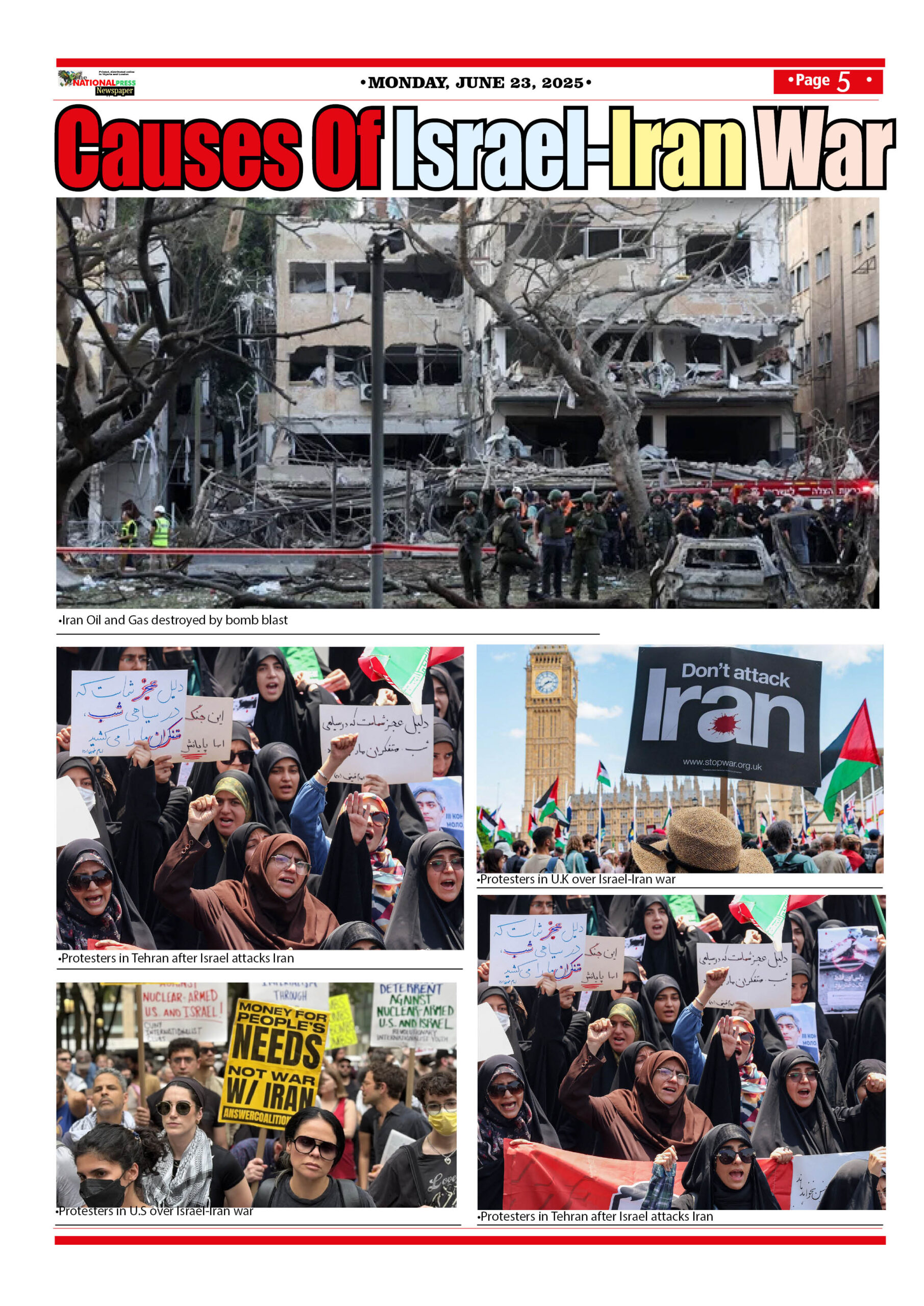
Written
BY Dr.Dauda Awwal,Senior Political Editor, World Affairs,
(The National Press Newspaper)
CAUSES OF ISRAEL-IRAN WAR
Written
BY Dr.Dauda Awwal,Senior Political Editor, World Affairs,
(The National Press Newspaper)
Decades longstanding strategic, ideological and politics responsible for Israel, Iran war
The war between Israel and Iran erupted on June 13, 2025. But its roots stretch back decades, shaped by longstanding strategic, ideological, and political factors.
Immediate spark June 2025 strikes:
Israel launched a surprise series of airstrikes on June 13, 2025, targeting Iran’s Nuclear and Military infrastructures, including missile sites and facilities in Natanz and Isfahan, cities necessary to thwart Tehran’s Advancing Nuclear Capabilities According to the media reports including Reuters.
Iran responded swiftly with a massive Ballistic Missile and Drone Barrage on Israel Territory on the same day.
Long-Term Causes:
- Routine shadow war and proxy battles for decades, Israel and Iran have engaged in a cover conflict-targeted assassinations of Nuclear Scientists, and IRGC Commanders. Airstrikes in Syria and Lebanon, and Cyber-espionage-al avoiding direct confrontation.
Iran has empowered proxy Groups like Hezbollah and Hamas, positioning them as part of an ‘Axis of Resistance’ meant to exert pressure on Israel. - Iran’s Nuclear Program
Israel believes a Nuclear-Armed Iran threatens its very existence. Tehran claims its nuclear activities are peaceful, but accumulating enriched Uranium and IAEA Findings have raised alarm.
Diplomatic Efforts, especially after the U.S. pull-out from the Atomic Agreement in 2018, stalled-prompting Israel to act unilaterally. - Escalatory Tit-For-Tat Dynamics
The cycle intensified following Hamas’s October 7, 2023 attack on Gaza including targeting Iranian proxies.
Confrontations escalated in April and October,2024-with strikes in Syria and Iran. Iran’s retaliatory strikes on Israel and numerous assassinations. - Political Leadership & Strategy
Iran’s Supreme Leader Khamenei and Israel’s Prime Minister, Netanyahu carry ideological Mandates-Khamenei supports the mission to resist Israel, and Netanyahu is resolved to pre-empt any existential threat.
The Reality of June 2025
This is Not a sudden outbreak, rather, it is the culmination of a decades-long strategic battle over existential threats, Nuclear Proliferation, proxy warfare, and mutual distrust. The direct 2025 Airstrikes on Nuclear and Military Sites Iran-followed by Iran’s unprecedented Missile-Drone Retaliation-mark the most overt and intense state of this conflict to date.
Quick Time of Escalation:
October 7,2023 Hamas’s Attack leads to Israel crackdown, Iran’s provides target Israel
April 2024 Israel strikes Iranian Consulate in Damascus
-Iran retaliates with Missiles/Drones
October,2024 Assassinations of Nasrallah, Haniyah-Iran fired 200 Missiles at Israel. Israel strikes Iran
June 13,2025 Israel launched major air campaign on Iran-Iran responded in kinds.
Figure 1
Awwal (2025)
Public Opinion:
Strong opposition to U.S Military Involvement:
60% of Americans opposed direct Military Action, with only 16-23 % in support, according to The Economist Magazine.
Over 50% support Diplomacy or Sanctions rather than intervention, with even a chunk of Donald Trump voters (53%) opposing Military involvement.
Within ‘MAGA’ Cycles, about 65% favor striking Iranian Military targets, but notable voices like Marjorie Taylor Greene and others urge restraint.
Government and Leadership Responses
White House & President Donald Trump
Trump praised Israel’s Strikes as ‘Excellent’ and warned Iran to capitulate or face further blow.
He is expected to make a decision within a couple of weeks, while still exploring Diplomacy via envoy-level talks.
The Biden Era framing historically has emphasized ‘Ironical’ defense of Israel but also urged restraint to prevent broader war.
Congress & War Powers
Lawmakers across Parties invoked the War Powers Act, stating that any U.S. strike on Iran would require congressional approval.
Bipartisan Voices-Senator Mitch McConnell, Speaker Mike Johnson, Senator Lindsey Graham, and Senator Schumer have expressed strong support for Israel and rushed military and packages to Congress. Some like Senator Rand Paul, cautioned strongly against U.S. entanglement.
State Department & Diplomacy:
Secretary Rubio emphasized Israel’s Autonomy in striking while pressing Iran not to threaten U.S. interests.
Secretary Blinken and U.S. diplomats are urging both sides to avoid escalation, though simultaneously reaffirming their commitment to Israel’s Defense.
Americans broadly support Israel but are reluctant to see U.S. Forces drawn in. Congress is drawing clear red lines around unilateral Military action, emphasizing legal and political processes.
The Executive branch is balancing support for Israel’s Security with attempts to avoid entangling U.S. forces in a broader Middle Eastern Conflict.
UK Government & Leadership
Prime Minister, Kier Starmer:
Called on all parties to ‘Step Back ‘ and return to Diplomacy, stressing the need to step away from the brink of a broader war. Recognises Israel’s right to self-defense but emphasizes de-escalation, including relocating RAF Jets as a contingency.
Described the situation as a ‘Very Dangerous Moment’ and is actively participating in Diplomatic discussions in Geneva engaging with European and Iranian Officials. Previously condemned Iran’s attacks at the United Nations, urging maximum restrain from all sides.
Chancellor Rachel Reeves:
Suggested that while No UK Forces will engage offensively, defensive measures may be provided to protect Israel.
Citizen Safety and Evacuations
The UK is arranging Charter Flights to evacuate citizens from Israel once airspace permits, after withdrawing Embassy Staff from Tehran. Issued Stark Travel Advisories and placed RAF Fighters on heightened alert in the region.
Military Posture
Under Operation Shader, RAF Typhoons have been deployed to the Middle East as a Defensive deterrent-they have not engaged but remain ready.
Measures are in place to safeguard UK Assets and Personnel, including the possible use of Diego Garcia if needed.
Public Opinion:
Approximately 54% of Britons believe the UK should Act as a neutral mediator-not support either side directly, only 12% back aiding Israel, and 40% back Iran.72% oppose sending British Troops, and 50% reject supplying arms to Israel, however,41% support Stricter Economic Sanctions on Iran.
Key Infrastructure Destroyed in Both Iran and Israel During the June 2025 War
IRAN: Targeted by Israeli Airstrikes Nuclear and Military Facilities.
Natanz Complex: Pilot fuel enrichment Hall with 1,700 centrifuges destroyed, plus Power Substation damage causing site-wide outrage.
Arak IR-40 Heavy-Water Reactor: Reactor Containment and Adjacent Water-Plant Tower Demolished.
Kermanshah Underground Missile Facility, Multiple Missile Storage Buildings, and Entry Tunnels Struck, with Silos Partially Collapsed.
SPND/Nuclear Research HQ: Central Nuclear Program Leadership Building wiped out.
IRIB (State Broadcasting HQ) in Tehran took heavy fire, causing broadcasting outrage Energy Infrastructure.
South Pars Gas Processing Plant: Major Natural Gas Facility hit and caught Fire.
Fajr-e Jam Gas Refinery (Busheir Province) struck, igniting a large blaze.
Shahran Oil Depot (North of Tehran): Hit, igniting fires among 11 vast fuel tanks.
Shahr-Rey Oil Refinery (South of Tehran): One of Iran’s biggest Refineries was damaged.
Civilian and Industrial Structures
14-Storey Residential Block near Nobonyad Square, Tehran collapsed completely-60 Killed, around 20 of them children.
Farda Motors Factory (Borujerd): Suffered heavy damage.
One Holding Tower: (Tehran)Sustained Structural Damages.
Welfare Department (Qasr-e Shirin) Building Destroyed.
Shiraz Electronics Industries Facility Damaged.
Air-Defense and Radar Installations
Multiple S-300 Missile Batteries (Imam Khomani Airport, Elam, were severely damaged.
Damaged detected at Air-Defense Systems at Bandar Imam Khomeini Port/Refinery, Tang-eh Bija Gas Field, Abadan Refinery.
Radar Sites
Khojr and Parchin Military Sites
Warehouses, Missile Production Buildings, Industrial Mixers Destroyed.
Isfahan Air Base: Radar/Air-Defense System Component Damaged.
ISRAEL:
Israel: Hit by Iranian missiles and Drone strikes.
Soroka Medical Centre (Beersheba): Struck by Iranian missiles (Cluster munitions) damaging the surgery wing and injuring 80.
Weizmann Institute of Science (Rehovot): One Lab Building collapsed, and others were heavily damaged-projected loss of $300-500 Million in research.
U.S. Embassy Building (Tel Aviv): Damaged during missile barrages.
Various Residential Buildings, Labs, and Public Markets Hit across Tel Aviv, Haifa, Petah Tikva, and Ramat resulting in civilian casualties.
Civilian Infrastructure Impacted: Homes, Streets, Shops, Hundreds Injured, Dozens Killed.
Summary Table:
Country Infrastructure Type Key Sites
Iran Nuclear/Military Natanz,Arak reactor,SPND Kermanshah,Missile Bases
Energy South Pars Plant, Fajr-e Jam Refinery ,Shahran and Shahr-Rey Depots
Civilian/Industrial Residential Block, Auto Factory, Electronics Firm
Air-Defense S-300 Batteries, Radar and Anti-Air Installations
Israel Medical Soroka Hospital
Research Weizmann Institute
Diplomatic U.S Embassy
Civilian Homes, Public Space in major cities
Figure 2
Awwal (2025)
Conclusion
The Israel-Iran Conflict of June 2025 marks the most direct, destructive phase in a decades-long shadow war. Unlike previous proxy skirmishes and covert operations, this confrontation features open, large-scale attacks on each Nation’s Homeland, with devastating consequences. Citizens in the U.S., UK, and even Israel and Iran show resistance to full-scale war and fear long-term consequences.
Global Leaders, including those from Europe and the UN, are urging de-escalation and dialogue to prevent regional war. Both countries saw high civilian impact-residential buildings destroyed, power systems damaged, and hospitals overwhelmed.
President Vladimir Putin has offered to mediate the conflict and shared peace proposals with both Nations, emphasizing Russia’s balanced relations with Iran and Israel. China imported 15% of its oil from Iran, but due to war disruptions. Beijing has officially called for de-escalation and offered to act as a mediator. President Xi warned that instability threatens global peace, and Foreign Minister Wang reiterated China’s willingness to play a constructive role.
Iran suffered the destruction of key nuclear sites, missile bases, oil refineries, and urban areas. Israel endured missile hits on a major hospital, research labs, and residential areas, with dozens of civilian casualties.
The war is not just about Israel vs Iran. It’s about Nuclear Fear, Regional Dominance, Ideological Rivalry, and Global Diplomacy under stress. Whether this conflict fades into a cold phase or sparks something much wider will depend on what comes next restraint, retaliation, or reconciliation.
Dr.Dauda Awwal
Senior Editor, World Affairs,
The National Press Newspaper, London
23rd June,2025


