


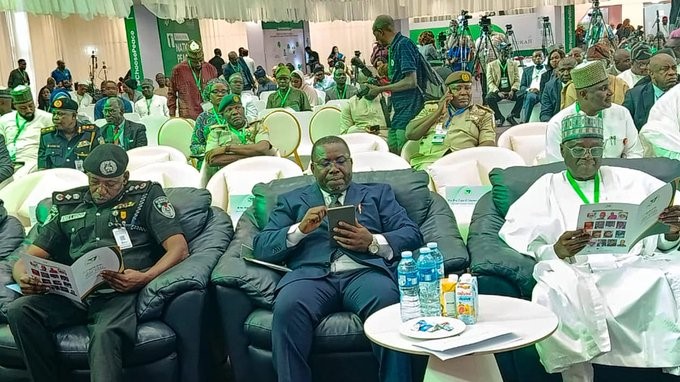
The Chairman of the Independent National Electoral Commission (INEC), Joash Amupitan, has urged political parties and candidates to make the 2027 election campaign a “marketplace of ideas” rather than a “theatre of war”.
Amupitan made the call on Tuesday in Abuja at the signing of the first National Peace Accord for the 2027 general elections, facilitated by the National Peace Committee led by former Head of State, General Abdulsalami Abubakar.
Addressing the presidential candidates and party leaders at the event, the INEC chairman described the document as more than a ceremonial agreement, saying it represented a commitment to the Nigerian people.
“The document you are about to sign is not a mere piece of paper. It is a covenant and a social contract with the Nigerian people, and it is a contract with statutory and constitutional flavour,” Amupitan said.
He urged political leaders to lead by example, noting that their supporters often take cues from their conduct and statements.
“Presidential candidates, if you speak the language of peace, they will act with peace; if you incite them, they will ignite,” he said.##
‘INEC Has No Candidate’
Amupitan assured Nigerians that INEC would remain neutral in the 2027 elections, stressing that the commission had no preferred candidate or political platform.
“Let me state unequivocally that INEC has no interest in who wins or loses any election, nor does it favour any political platform. Our only interest is a lawful, transparent, credible and inclusive process,” he said.
He further urged all registered political parties, presidential candidates and other candidates to internalise the commitments contained in the peace agreement.
The National Peace Committee introduced the peace accord ahead of the 2015 general elections as part of efforts to promote peaceful elections, mediate political disputes and encourage political actors to accept electoral outcomes.
The 2015 accord was signed by then-presidential candidates Goodluck Jonathan and Muhammadu Buhari and preceded Nigeria’s first democratic transfer of power from an incumbent ruling party to an opposition party since the return to democracy in 1999. The initiative has since been extended to several off-cycle governorship elections across the country.
The accord commits political parties and their candidates to peaceful conduct and issue-based campaigns before, during, and after the elections.


