

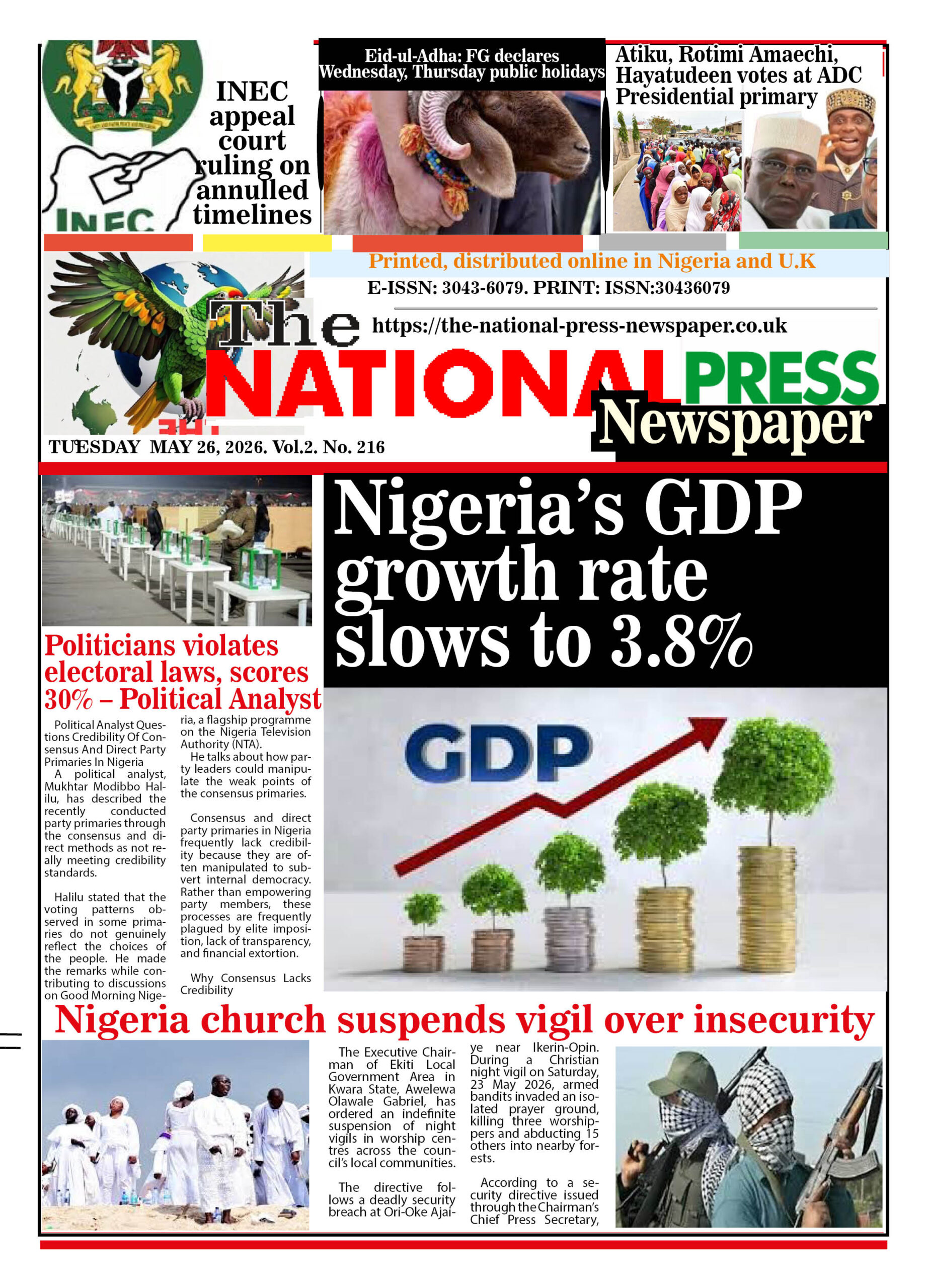
The National Press Newspaper cover for Tuesday May 26, 2026
INEC appeal court ruling on annulled timelines
https://the-national-press-newspaper.co.uk/inec-appeal-court-ruling-on-annulled-timelines/
The Independent National Electoral Commission (INEC) has officially approached the Abuja Division of the Court of Appeal to overturn a Federal High Court judgment that nullified critical parts of its 2027 general election timetable.
The High Court Verdict: Justice Mohammed Umar of the Federal High Court in Abuja ruled that INEC lacks the statutory powers to shorten, extend, or alter electoral timelines explicitly guaranteed under the Electoral Act 2026.
The Annulled Timelines: The court voided INEC’s administrative deadlines concerning party primaries, submission of party membership databases (which INEC had fixed for May 10, 2026), substitution of candidates, publication of final candidate lists, and the cessation of political campaigns.
The Legal Standard: The court reaffirmed that political parties are legally permitted to submit candidate particulars up to 120 days before the election date, shifting the membership register deadline to September 2026.
The Grounds for Appeal: INEC argues that the ruling significantly disrupts its administrative flexibility, election planning, and logistical coordination for the 2027 elections.
The Legal Battle: Legal experts note that while opposition parties are celebrating the judgment as a win for internal party autonomy, the ruling remains binding until a higher court grants a stay of execution or vacates it on appeal.
Increased Defection Window: Lawyers note that the extended deadlines temporarily create a wider window for politicians who lose primary elections in major parties to defect to other platforms.
Calls for Compliance: Civil society groups and political coalitions, such as the Coalition of United Political Parties (CUPP), have urged INEC to respect the rule of law and adjust its schedule rather than pursuing a prolonged legal battl
public holiday
Eid-ul-Adha: FG declares Wednesday, Thursday public holidays
https://the-national-press-newspaper.co.uk/eid-ul-adha-fg-declares-wednesday-thursday-public-holidays/
The Federal Government of Nigeria declared Wednesday, May 27, and Thursday, May 28, as public holidays to mark the 2026 Eid-el-Kabir (Eid-ul-Adha) celebrations.
In a statement signed by Permanent Secretary Dr. Magdalene Ajani, Minister of Interior Dr. Olubunmi Tunji-Ojo announced the holidays to mark the Islamic festival of sacrifice and obedience. The government felicitated with the Muslim Ummah, encouraging Nigerians to use the period for reflection, prayer, and fostering unity.
Atiku
Atiku, Amaechi, Hayatudeen votes at ADC Presidential primary
https://the-national-press-newspaper.co.uk/atiku-amaechi-hayatudeen-votes-at-adc-presidential-primary/
Former Vice President Atiku Abubakar and former Minister of Transportation Rotimi Amaechi have officially cast their votes in the African Democratic Congress (ADC) nationwide direct presidential primary election.
Atiku Abubakar cast his ballot at the Ajiya Ward Polling Unit in Jimeta, Yola, Adamawa State.
Rotimi Amaechi voted simultaneously at Ward 5 in Ubima, Ikwerre Local Government Area of Rivers State.
Mohammed Hayatu-Deen, the prominent economist and third cleared aspirant in the race, cast his vote in Borno State.
The ADC implemented a nationwide direct primary following the collapse of consensus talks between the aspirants.
Voting is taking place across all 8,809 wards in the 36 states and the Federal Capital Territory (FCT).
The election utilizes the Option A4 voting method, requiring accredited party members to line up openly behind posters of their chosen aspirant.
Candidate Positions and Statements
Atiku Abubakar favoured to win the Preidential primary of ADC, characterized the primary as “democracy at work” and a crucial initial step toward reclaiming the country.
Rotimi Amaechi challenged Atiku’s track record during interviews, asserting that electability, rather than past attempts, should guide voters. He also urged supporters to vote based on merit over regional or religious ties.
Mohammed Hayatu-Deen cautioned the party against selecting “recycled politics” and positioned himself as a baggage-free candidate capable of uniting different generation
GDP
Nigeria’s GDP growth rate slows to 3.8%
https://the-national-press-newspaper.co.uk/nigerias-gdp-growth-rate-slows-to-3-8/
The National Bureau of Statistics (NBS) says Nigeria’s gross domestic product (GDP) growth rate slowed to 3.89 percent year-on-year in real terms in the first quarter (Q1) of 2026.
The bureau announced the development in its latest GDP report for Q1 2026 on Monday.
Nigeria’s Gross Domestic Product (GDP) growth rate slowed slightly to 3.89% year-on-year in real terms for the first quarter (Q1) of 2026.
According to data released by the National Bureau of Statistics (NBS), the pace of economic expansion dipped from the 4.07% growth rate recorded in the final quarter (Q4) of 2025. Despite the marginal quarter-on-quarter deceleration, this figure represents a year-on-year improvement compared to the 3.13% growth recorded in Q1 2025.
Economic momentum softened because growth slowed in both the oil and non-oil sectors compared to Q4 2025.
Nigeria’s average daily crude production fell to 1.55 million barrels per day (mbpd), down from the 1.58 mbpd maintained in the previous quarter.
While the economy has picked up pace since the implementation of aggressive fiscal adjustments—such as fuel subsidy removal and currency devaluation—this 3.89% performance stays well short of the 7% annual growth targeted by the government for 2027.
The following table provides context on how Nigeria’s recent economic growth compares over consecutive quarters:
Period Real GDP Growth Rate (YoY) Key Economic Driver
Q1 2026 3.89% Softening output in both oil & non-oil sectors
Q4 2025 4.07% Accelerating oil sector growth (6.79%)
Q3 2025 3.98% Services sector expansion
Q2 2025 4.23% Rebased framework momentum
Q1 2025 3.13% Early post-rebasing tracking
no more vigil
Nigeria church suspends vigil over insecurity
https://the-national-press-newspaper.co.uk/nigeria-church-suspends-vigil-over-insecurity/
The Executive Chairman of Ekiti Local Government Area in Kwara State, Awelewa Olawale Gabriel, has ordered an indefinite suspension of night vigils in worship centres across the council’s local communities.
The directive follows a deadly security breach at Ori-Oke Ajaiye near Ikerin-Opin. During a Christian night vigil on Saturday, 23 May 2026, armed bandits invaded an isolated prayer ground, killing three worshippers and abducting 15 others into nearby forests.
According to a security directive issued through the Chairman’s Chief Press Secretary, Prince Dada Sunday, new guidelines have been enforced to maintain community safety:
Religious bodies operating in isolated or outlying areas must move their services to community centres located directly within towns and villages.
Daytime services in these areas are now strictly capped at a maximum of two hours.
Local authorities expressed disappointment that the affected church conducted night services in a secluded location despite previous safety warnings delivered through the Christian Association of Nigeria (CAN) and the League of Imams.
The Kwara State Police Command, under Commissioner of Police Ojo Adekimi, has condemned the attack as barbaric. Tactical units, including the police drone team and PMF personnel, have launched joint bush-combing and intelligence-led search operations to rescue the abducted victims and apprehend the criminal
politics
Political Analyst Questions Credibility Of Consensus And Direct Party Primaries In Nigeria
https://the-national-press-newspaper.co.uk/political-analyst-questions-credibility-of-consensus-and-direct-party-primaries-in-nigeria/
A political analyst, Mukhtar Modibbo Halilu, has described the recently conducted party primaries through the consensus and direct methods as not really meeting credibility standards.
Halilu stated that the voting patterns observed in some primaries do not genuinely reflect the choices of the people. He made the remarks while contributing to discussions on Good Morning Nigeria, a flagship programme on the Nigeria Television Authority (NTA).
He talks about how party leaders could manipulate the weak points of the consensus primaries.
Consensus and direct party primaries in Nigeria frequently lack credibility because they are often manipulated to subvert internal democracy. Rather than empowering party members, these processes are frequently plagued by elite imposition, lack of transparency, and financial extortion.
Why Consensus Lacks Credibility
Elite Imposition: Instead of genuine agreement among all aspirants, consensus is often used by governors and party leaders to force unpopular candidates on the electorate.
The Electoral Act 2022 strictly requires the written consent of all cleared aspirants for a consensus to be valid. If even one aspirant disagrees, the party is legally bound to conduct a primary election, a rule frequently flouted.
The consensus model completely silences the grassroots party members, centralizing candidate selection in the hands of a powerful few.
Why Direct Primaries Lack Credibility
Logistical Failures & Violence: Direct primaries require meticulous logistical planning and updated voter registries. Without them, the process is routinely marred by chaos, rigging, and violence.
Financial Extortion: Direct primaries demand massive financial mobilization across polling units, making them susceptible to the “highest bidder” and financially crippling for capable but less wealthy aspirants.
Lack of Transparent Registers: Most political parties lack accurate, up-to-date, and officially published databases of card-carrying members, which allows for the stuffing of ballot boxes and the arbitrary falsification of results.
Civil society organizations like Yiaga Africa consistently advocate for strict adherence to electoral laws and improved transparency, stressing that credible primaries are essential to Nigeria’s democratic development


