

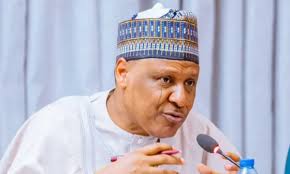
Minister of Information and National Orientation, Mohammed Idris, in an op-ed titled “A Defining Moment for Nigeria: Why Staying the Course Matters,” noted that the economic reforms by the current administration are already yielding positive results.
The proposed 2026 budget, presented by President Tinubu in December 2025, totals ₦ 58.18 trillion, focusing on security, infrastructure, health, and education.
The key assumptions in the budget include a $64.85 oil benchmark, 1.84 million barrels of oil per day production, and a $1,400 exchange rate.
“Our ‘Budget of Consolidation, Renewed Resilience and Shared Prosperity’ is critical. It is a commitment to double down on what is working, to solidify gains, and to ensure that the shared prosperity we speak of becomes a lived reality for more Nigerians, faster,” Idris stated.
The 2026 Federal Budget of Nigeria, presented by President Bola Ahmed Tinubu on December 19, 2025, is themed the “Budget of Consolidation, Renewed Resilience, and Shared Prosperity.”. It is designed to solidify the gains of ongoing economic reforms and transition the nation from “survival to growth”.
Key Budget Aggregates
The 2026 budget proposal outlines a significant increase in both revenue and expenditure targets compared to previous years:
Total Expenditure: ₦58.18 trillion.
Total Expected Revenue: ₦34.33 trillion.
Budget Deficit: ₦23.85 trillion (approximately 4.28% of GDP).
Debt Servicing: ₦15.52 trillion.
Capital Expenditure: ₦26.08 trillion.
Recurrent (Non-Debt) Expenditure: ₦15.25 trillion.
Economic Assumptions for 2026
The budget is based on several key macroeconomic projections:
Oil Price Benchmark: $64.85 per barrel.
Oil Production Target: 1.84 million barrels per day.
Exchange Rate: ₦1,400 to US$1.
Inflation Outlook: Expected to continue a downward trend throughout 2026, following a decline to 14.45% in late 2025.
Strategic Economic Priorities
To solidify the economy, the government has allocated significant funds to the following key sectors:
Defence and Security (₦5.41 trillion): Focused on modernizing the Armed Forces and implementing a new national counterterrorism doctrine.
Infrastructure (₦3.56 trillion): Priorities include completing the Coastal Highway, Sokoto–Badagry Expressway, Ajaokuta–Kaduna–Kano (AKK) Gas Pipeline, and various rail developments.
Education (₦3.52 trillion): Includes expanding the Nigerian Education Loan Fund (NELFUND).
Health (₦2.48 trillion): Aimed at improving healthcare access and productivity, representing 6% of the total budget size.
Food Security: Focuses on mechanization through seven regional hubs, recapitalizing the Bank of Agriculture, and expanding irrigation to cultivate one million hectares of land.
Reform Implementation
The 2026 fiscal year emphasizes stricter budget discipline and revenue generation:
Tax Reforms: Implementation of the new National Tax Acts to broaden the tax net and improve efficiency.
Digitization: Deployment of end-to-end e-collections and real-time performance dashboards for government-owned enterprises to seal revenue leakages.
“Nigeria First” Policy: A mandate for all government agencies to prioritize Nigerian-made goods and local companies in procurement to support domestic industry.


