

Suuratul-Faatihah-Chapter 1 of the Holy Qur’an for Adults
SAMPLE
ENGLISH-YORUBA QUR’AN 4-in-1
With Full Arabic Text, Full Transliteration, Yoruba & English Translations with Commentary, Scientific References, Biblical references and World Affairs Insights
By: Dr.Dauda Awwal,
Graduate of Muhammad Ibn Saud University, Riyadh
(VOLUME 1: SURATUL-FAATIHAH-CHAPTER 1 OF THE GLORIOUS QUR’AN)
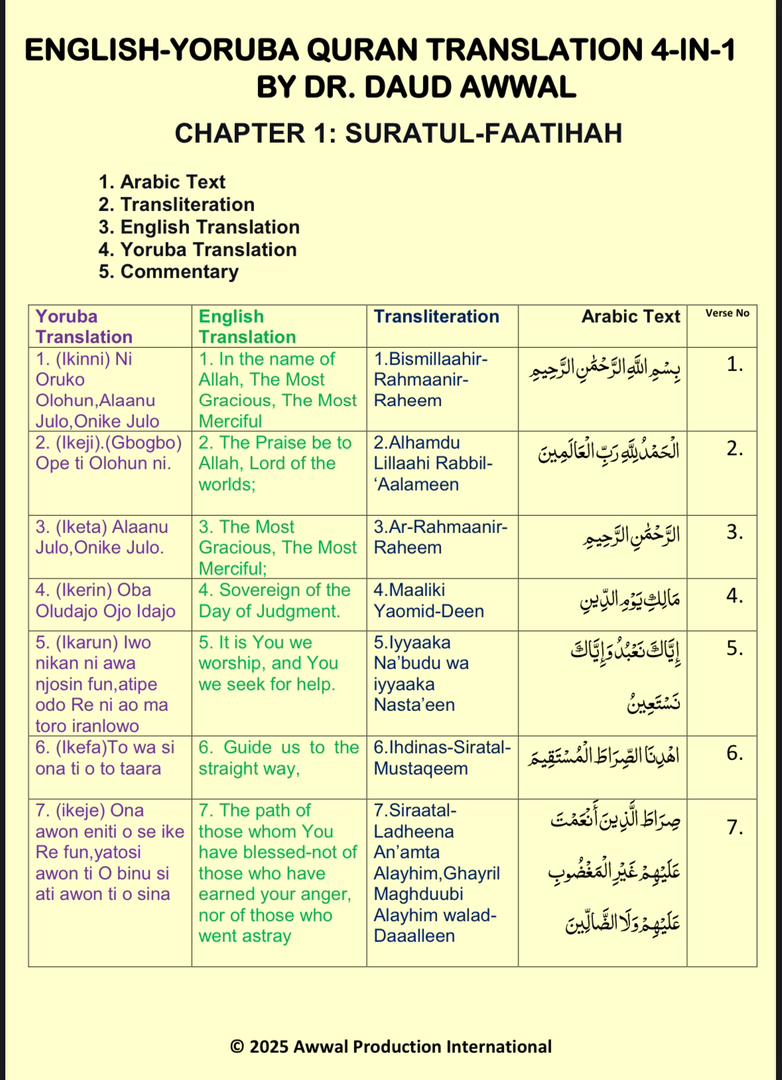
CHAPTER 1: SURATUL-FAATIHAH
1-Arabic Text
بِسْمِ اللَّهِ الرَّحْمَٰنِ الرَّحِيمِ
الْحَمْدُ لِلَّهِ رَبِّ الْعَالَمِينَ
الرَّحْمَٰنِ الرَّحِيمِ
مَالِكِ يَوْمِ الدِّينِ
إِيَّاكَ نَعْبُدُ وَإِيَّاكَ نَسْتَعِينُ
اهْدِنَا الصِّرَاطَ الْمُسْتَقِيمَ
صِرَاطَ الَّذِينَ أَنْعَمْتَ عَلَيْهِمْ غَيْرِ الْمَغْضُوبِ عَلَيْهِمْ وَلَا الضَّالِّينَ
Transliteration
1.Bismillaahir-Rahmaanir-Raheem
2.Alhamdu Lillaahi Rabbil- ‘Aalameen
3.Ar-Rahmaani Ar-Raheem
4.Maaliki Yaomid-Deen
5.Iyyaaka Na’budu wa iyyaaka Nasta’een
6.Ihdinas-Siratal-Mustaqeem
7.Siraatal-Ladheena An’amta Alayhim,Ghayril Maghduubi Alayhim walad-Daaalleen
3.English Translation
SURATUL- FAATIHAH-THE OPENING
In the name of Allah, the Most Gracious, the Most Merciful.
Praise is due to Allah, Lord of the worlds.
The Most Gracious, the Most Merciful.
Sovereign of the Day of Judgment.
It is You we worship, and it is You we seek for help.
Guide us to the straight way,
The way of those on whom You have bestowed Your Grace, not those whose earned (Your) anger, and not those who went astray.
4.Yoruba Translation
Ni Oruko Olohun,Alaanu Julo,Onike Julo
1.(Ikinni). Ni Oruko Olohun, Alaanu Julo, Onike Julo
- (Ikeji). Ope naa ti Olohun ni.
3.(Iketa). Alaanu Julo, Onike Julo. - (Ikerin). Oba Olukapa Ojo Idajo
- (Ikarun), Iwo nikan ni awa njosin fun, atipe odo Re ni ao ma toro iranlowo
- (Ikefa). To wa si oju-ona ti o to taara
- (Ikeje). Ona awon eniti o se ike Re fun, yato si awon ti O binu si ati awon ti o sina
What Does This Chapter Mean?
Suratul-Faatihah is the first Chapter of the Holy Qur’an. It is like a special prayer to Allah that Muslims say every day during the obligatory prayer.
They start by praising Allah-He is the Most Kind and Most Merciful.
They say He is the King of the Day of Judgement.
They promise to worship Him only and ask Him for help.
They ask Allah to guide them to the straight path-the way of good people who Allah loves.
Commentary:
Bismillaahir-Rahmaanir-Raheem
Verse 1: ‘’In the Name of Allah, the Most Compassionate, the Most Merciful’’
Biblical Reference:
Similar to how many Psalms begin by invoking the name and mercy of God (e.g., ‘’Give thanks to the LORD, for He is good, His love endures forever.’’-Psalm 136:1).
The repeated attributes of compassion and mercy mirror God’s mercy described in Exodus 34:6:
‘’The LORD. the compassionate and gracious God, slow to anger, abounding in love and faithfulness.’’
Scientific Insight:
Gratitude and invoking a divine name before tasks (Similar to saying ‘’Bismillaah’’) are known to lower stress levels and improve focus, as proven by psychological studies on mindfulness and prayer.
Verse 2: ‘’Praise is due to Allah. The Lord of the Worlds.’’
Biblical Reference:
Psalm 24:1- ‘’The earth is the LORD’s and everything in it, the World, and all who live in it.’’
This mirrors the Qur’anic acknowledgment of God as the Sustainer of all realms (physical and spiritual).:
Scientific Insight:
Modern science confirms that Interconnectedness of all ecosystems (biosphere, atmosphere, etc.)-a concept that aligns with the idea of ‘worlds’ (Al-aalameen).
Verse 3: ‘’The Most Compassionate, the Most Merciful’’
Biblical Reference:
Lamentations 3;22-23- ‘’Because of the LORD’s great love we are not consumed, for his compassions never fail. They are new every morning’’
Scientific Insight:
Studies in neuroplasticity show that mercy and forgiveness enhance brain health and emotional well-being-reinforcing divine mercy as a model for human behaviour.
Verse 4 ‘’Master of the Day of Judgement’’
Biblical Reference:
Hebrew 9;27-‘It is appointed unto men once to die, but after this the judgement.’’
Revelation 20;12 describes the final judgement where all deeds are accounted for:
Scientific Insight:
While science doesn’t comment on judgement day, it recognises the moral and psychological effects of accountability-societies with a belief in divine accountability tend to maintain higher ethical standards.
Verse 5: ‘’You alone we worship, and You alone we ask for help.’’
Biblical Reference:
Matthew 4;10-Worship the Lord, your Gog, and serve him only’.’’
Scientific Insight:
Prayer and supplication are proven to reduce anxiety and enhance emotional resilience. Studies in neuroscience show that prayer activate brain regions linked with empathy and self-control.
Verse 6; ‘’Guide us to the Straight Way’’
Biblical Reference:
Psalm 27;11- ‘’Teach me way LORD; Lead me in a straight path because of my oppressors.’’
Scientific Insight:
Seeking guidance alights with the human psychological need for purpose-a concept discussed in positive psychology (Viktor Frank’s work on meaning and direction).
Verse 7: ‘’The path of those whom You have blessed-not of those who have earned your anger, nor of those who go astray’’
Biblical Reference:
Deuteronomy 11;26-28-Blessings for those who obey and curses for those who turn away.
Matthew 7;13-14-‘’Enter through the narrow gate, the road that leads to life is narrow, and only a few find it.’’
Scientific Insight:
The emphasis on correct moral choices parallels modern ethical decision-making frameworks that show morality impacts long-term societal and personal well-being.
Summary of Biblical & scientific Parallels:
Mercy & Compassion: Shared values in Psalms, Exodus, and Qur’anic attributes
(Ar-Rahmaan Ar-Ar-Raheem).
Oneness of God: A central concept echoed in both the Old and New Testaments.
Guidance & Accountability: Both the Bible and Qur’an emphasize divine guidance, moral choices, and consequences.
Science: Prayer, gratitude, and moral living are linked with mental and emotional health, confirming some of the wisdom embedded in Suratul-Faatihah.
What Prophet Muhammad, his Sahabah and Tafseer Ibn Katheer say about this Chapter including its virtues, essential rulings and classical interpretations
Prophet Teachings & Sahabah Statements about Suratul-Faatihah
1.Essential for Prayer
‘’Ubadah Ibn As-Saamit reported that Rasulullaah (S.A.W) SAID;
‘’There is no prayer for one who does not recite the Faatihah of the Book’’
(Sahihul-Bukhari & Muslim).
2.The Mother of the Qur’an
It is known as Ummul-Qur’aan (‘’Mother of the Qur’an’’) and Ummul-Kitaab (‘’Mother of the Book’’), and it is also called As-Sabul-Mathaanee (The seven of repeated verses’’)
As narrated:
‘’I shall teach the greatest Surah…’’ referring to Suratul-Faatihah and explaining; ‘’It is the seven oft-repeated, and the mighty Qur’an which I have been given.’’
3.Cure and Healing
A narration relates that when companions found someone unconscious, they recited Al-Faatihah and blew into his ear. He was healed. Upon hearing this, the Prophet Muhammad (S.A.W) said;
‘’It is the Mother of the Qur’aan and a cure for every disease.’’
4.Slow, Reflective Recitation
Ummu Salamah said the Prophet (S.A.W) recited Al-Fatihah verse by verse, pausing between each verse to reflect-this is the Sunah.
These pauses aid reflection with Allah, and improve clarity of recitation.
Ibn Kathir & Classically Commentary
1.Seven Verses & Basmalah as an Ayah
Ibn Kathir affirms that Al-Fatihah contains 7 verses, and that Bismillaahir-Rahmaanir-Raheem is considered an integral verse (Ayah) by many Scholars like Ibn Abbas, Ibn Umar and Ali (Radiyallaahu An’hum).
2.Summary of Its Message
Ibn Kathir states that Fatihah:
Praise and thank Allah, highlighting His names and attributes
Asserts divine Sovereignty over the Day of Judgement and destiny.
Call for sincere worship and reliance upon Allah alone.
Begging for guidance, direction, and protection from error.
Warn against paths that draw anger or misguidance, affirming that believers strive to be with righteous on Judgement Day.
Key Notes:
Fatihah is obligatory in every rak’ah of prayer-without it, the prayer is considered invalid.
It is deeply revered as the foundation of the Qur’an and the core of worship.
Its themes of praise, supplication, divine guidance, and moral integrity encapsulate the essential message of Islam.
Reflective recitation, as practiced by the Prophet Muhammad (S.A.W) enhances spiritual presence and connection.
Footnotes:
1.Laa Salaata liman lam yaqrau bil-Faatihatil-Kitaab’’-’No prayer without Al-Fatihah’
Source: Sahih al-Bukhari (Hadith 756), Sahih Muslim (Hadith 394)-reported by Ubadah ibn As-Saamit.
2.Al-Faatihah is the Mother of the Qur’an
Source: Sahih al-Bukhari (Hadith 4703),Sahih Muslim (811),Sunan Abu Dawood (Hadith 1457).
3.‘’Al-Hamdu lillaahi Rabbil-Aalameen is Ummuul Qur’aan,Ummul-Kitaab, and the Seven oft-Repeated Verse’’-Prophet Muhammad (S.A.W).
Healing Power of Faatihah:
Source: Sahih al-Bukhari (Hadith 5736), where a companion recited Faatihah as ruqyah to heal a tribal chief.
4.Greatest Surah
Source: Sahih al-Bukhari (Hadith 4474)-The Prophet (S.A.W) told Abu Sa’is ibn al-Mu’alla ‘’I will teach you the greatest Surah in the Qur’an; Al-Hamdu lillaahi Rabbil-Aalameen.
Qur’anic references
Suratul-HIJR (15;87); ‘’We have given you the seven oft-repeated (verses) and the magnificent Qur’an. ’’This is understood by scholars to refer to Suratul-Faatihah.
Tafsir References (Ibn Kathir & Other Scholars)
Tafsir Ibn Kathir-commentary on Suratul-Faatihah emphasizes
Its 7 verses including Basmala.
Its themes of worship, guidance and praise
The division of the surah between Allah and His servant. ’Half for Me and half for my servant’’ (Hadithul-Quds).
At-Tabari & Al-Qurtubi-both described this chapter as the essence of the Qur’an due to its encapsulation of praise and guidance.
Sahabah Reports:
Ummu Salamah (Radiyallahu An’ha): Narrated that that the Prophet (S.A.W) recited each verse of Faatihah distinctly and pauses (Musnad Ahmad 44/43).
Ibn Abbas (R.a): Called this Surah ‘’the key to the Qur’an’’.
Classical Scholars
Ibn Kathir; Al-Faatihah is a comprehensive prayer containing praise to Allah, affirmation of His Lordship and Mercy, acknowledgement of the Day of Judgement, and a request for guidance’’
Reference: Tafseer Ibn Katheer (Volume 1,pg.18-25)
Imam An-Nawawi: In Sharhu Muslim, he affirms the consensus that Faatihah must be recited in every rak’ah of Salat.
Modern References & Studies:
Scientific perspective: Research on prayer and mindfulness (Harvard Medical School,2019) supports that prayer reduces anxiety and increases focus, which complements the spiritual essence of Faatihah.
Comparative Religious Studies: The Bible’s Lord’s Prayer (Matthew 6;9-13) parallels Al-Faatihah in invoking God’s praise, kingdom, and guidance.
Dr.Dauda Awwal
Graduate of Muhammad Ibn Saud University, Riyadh,
Author, First English-Yoruba Qur’an Translation 4-in-1
21st September,2025.


